How to Report Expanded Measurement Uncertainty (with a Worked Example)
Identify the measurand, distinguish standard and expanded uncertainty, and apply the stated decision rule.
Report the measured quantity and unit, the uncertainty value and its type, and the coverage factor if the uncertainty is expanded. A statement of conformity also needs a decision rule that says how the result and uncertainty are used against the specification.
State what the measurement represents
Define the measurand, the quantity you intend to measure. “Mass of peptide moiety in the submitted vial” gives more context than “peptide amount.” Specify the material, sample or population, and the chemical and reporting basis when relevant. For example, an individual vial result and a mean over a defined group of vials can share the same unit while referring to different quantities.
Measurement uncertainty describes the dispersion of values that can reasonably be attributed to the measurand given the information used. Contributions can include replicate variation, reference values, sample preparation, calibration and corrections. The uncertainty of a result for an individual vial addresses the defined measurement. An estimate for a lot may need additional sampling information.
Read the meaning of the plus or minus sign
A number after ± may be a replicate standard deviation, combined standard uncertainty or expanded uncertainty. Find the label and the method used to obtain it. Expanded uncertainty U equals the combined standard uncertainty multiplied by the coverage factor k. Record the uncertainty type, unit, coverage factor and the basis for any stated coverage probability.
Apply the rule for a lower specification
For a conformity statement, record the specification and the rule used to compare the measurement with it. JCGM 106 explains simple and guarded acceptance and the associated risks of false acceptance and false rejection. In a research comparison, check whether the uncertainty is small enough relative to the difference the study needs to resolve.
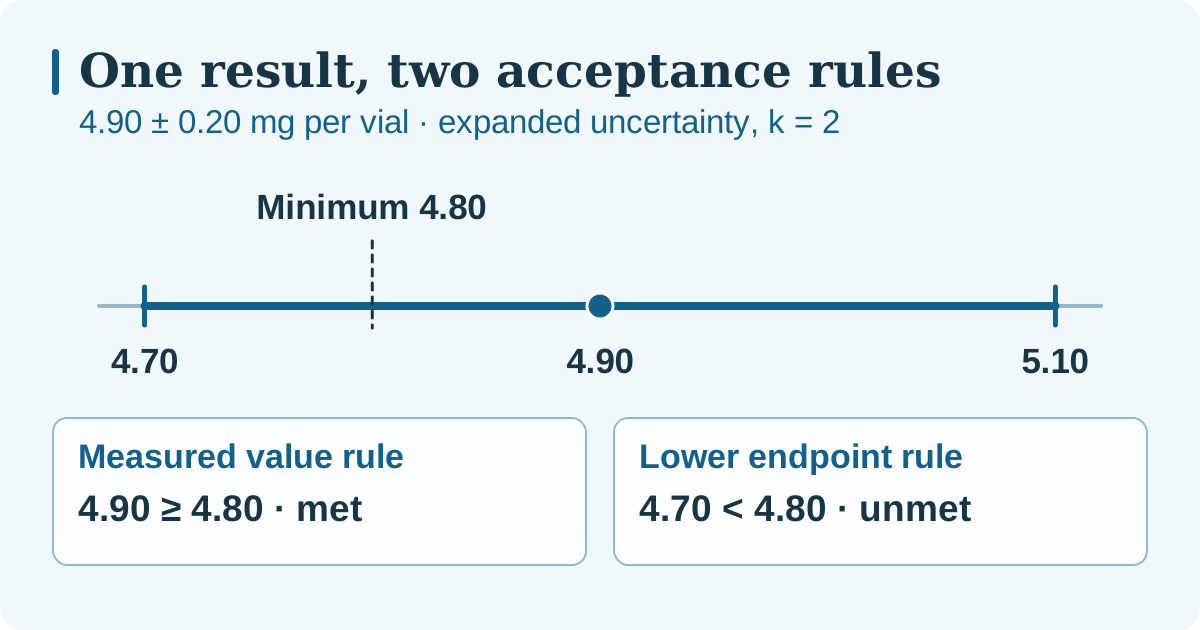
Measurand. Mass of the target peptide moiety in one submitted vial, reported in mg per vial. The fictional result is (4.90 ± 0.20) mg per vial, with expanded uncertainty U = 0.20 mg per vial and coverage factor k = 2. The combined standard uncertainty uc is 0.20 ÷ 2 = 0.10 mg per vial. The expanded interval runs from 4.70 to 5.10 mg per vial.
Coverage assumption. If a normal distribution is a suitable approximation and the effective degrees of freedom are sufficiently large, k = 2 gives approximately 95% coverage. State the basis when reporting a coverage probability.
| Teaching rule | Quantity compared with the minimum | Comparison (mg per vial) | Decision under the stated rule |
|---|---|---|---|
| Simple acceptance by measured value | Measured value y = 4.90 | 4.90 ≥ 4.80 | Meets the acceptance criterion. |
| Guarded acceptance by lower interval endpoint | y − U = 4.90 − 0.20 = 4.70 | 4.70 < 4.80 | Acceptance criterion unmet under this rule. |
Record which rule the procedure or agreement specifies. A result that does not meet the guarded acceptance criterion may need a separate decision about how to report conformity.
JCGM 106, The role of measurement uncertainty in conformity assessment · NIST TN 1297, Appendix B, Coverage Factors
Document the reference chain
Where traceability is relevant, record the reference standards and calibration evidence supporting the result. Metrological traceability is a property of a measurement result supported by a documented, unbroken chain of calibrations to a reference, with uncertainty contributions along the chain. Keep the uncertainty statement and any decision rule with the measured result so a reader can interpret it independently of a pass label.